Wow. It really works! Astrophotography!

Well all the hard work has paid off. Here is a photo of the Pleiades.

After weeks of fully clouded skies days and nights… We had a clear night. And was I tired. I just went to bed.

I woke at about 4:30am, and went out and set up a reception experiement for weather satellite photos, and saw the sky was cool and clear…

So I brought all the equipment out to my back patio.. did a quick polar alignment with my red dot finder. Put the camera on and took a few test shots of a star.

It seemed to work for a 30 second photo… AND I focused by eye! The stars were so bright I could see them in the viewfinder.

And Oh Oh!.. There is Jupiter and to the left plain as day is the Pleiades, So I aimed the camera at it as best I could and took 12, 30 second shots… Stacked them… no calibration frames, cropped it and that’s what I got. Nice round stars!

Perseid Meteor Shower? I might actually need an umbrella.

Well. As I’ve done for most of my backyard astronomy life, I find myself at the big meteor shower of the summer, the Perseids, and as usual.. the weather prediction is for clouds.

Why… Why do I do astronomy in a light polluted, notoriously cloudy city?

According to the weather, it may clear up a bit in the 2am and 3am hours tonight, which is close enough to the peak time, that I might just give up a nights sleep over the hope.

I’d like to set up the barn door tracker, put the 40mm lens on the camera and aim it at the shower’s radiating point. With the tracker I think I can take 1 minute exposures (if I set my iso carefully) and maybe catch some meteor trails with a nice star field in the background.

The nice thing is with nice bright Jupiter up at that time, I know I’ll be able to use it to get a sharp focus.

This is something I can safely start running with my intervalometer and go inside and take a nap.. Or.. wait… it could just rain all over my camera… Ok, so no sleep for me.

Better Finder Scope Attachment for the Barn Door Tracker

Well, I’ve designed solid mounts so that I can mount my red dot finder to my camera and to the barn door tracker. What was going wrong in the first version is that there was a lot of wobble in the mounts. My fault, because my design for the shoe for the finder was inherently wobbly. The current attempt is based on a design on thingiverse.com, for basically a type of dovetail rail that the finder scope can attach too. The finder comes with it attached to an adapter to a Synta style shoe. And there’s absolutely no problem with that, except in my setup.. Here is a link if you want to buy one:

As you can see, the finder itself is clamped on to a pedestal that then attaches in to a shoe on a telescope… In my case that pedestal is so high, it limits the positions I can angle my camera to. So on thingiverse.com is a rail meant for my particular tracker that would accept a similar type of finder scope. Not exactly mine, but I used it as a starting point for my design. I ended up with a rail I can bolt to my tracker, has a low profile, and then I can slide the finder on and off and there is no wobble.

Rail for Barn Door Tracker

I also melded that rail design to a hot shoe mount, printed that, and that fits nice and snug into my camera hot shoe also without wobble.

Rail with Hot Shoe Mount

So the idea, as I think I explained in another blog entry, is that since the finder has alt/az thumbscrews on it that are normally used to align it to a telescope, I couldn’t count on those screws never turning. So without a reference of what 0 alt/0 az is, I saw no way to align it to my barn door tracker. There’s nothing on the tracker with which to sight the north star, to correct the aim of the finder. So my theory goes.. if my hot shoe is square and level to my camera lens axis, I can put the finder onto the camera, align it to the camera while sighting a star in the exact center of the camera frame and then adjust the thumb screws on the finder to line it up– conveniently my camera displays the square central focus spot through the viewfinder so I can really get exact. Once the finder is lined up, I can move it to the barn door tracker, and do a polar alignment.

So that’s step 1 in eliminating star trails. The tracker has to be well aligned to the pole. And I have to wait, looking like a week, for clear skies to try it.

A Much better Moon Photo! and some planets!

Again woke up at 4am, as is my pattern now I check the weather app and it says “mostly clear” so, ok, why sleep. I can go out and at least line up the finder scope to the camera… All photos here were done without the tracker, on a tripod– 200mm focal length, and yeah… maybe this was dumb but the lens at F8…

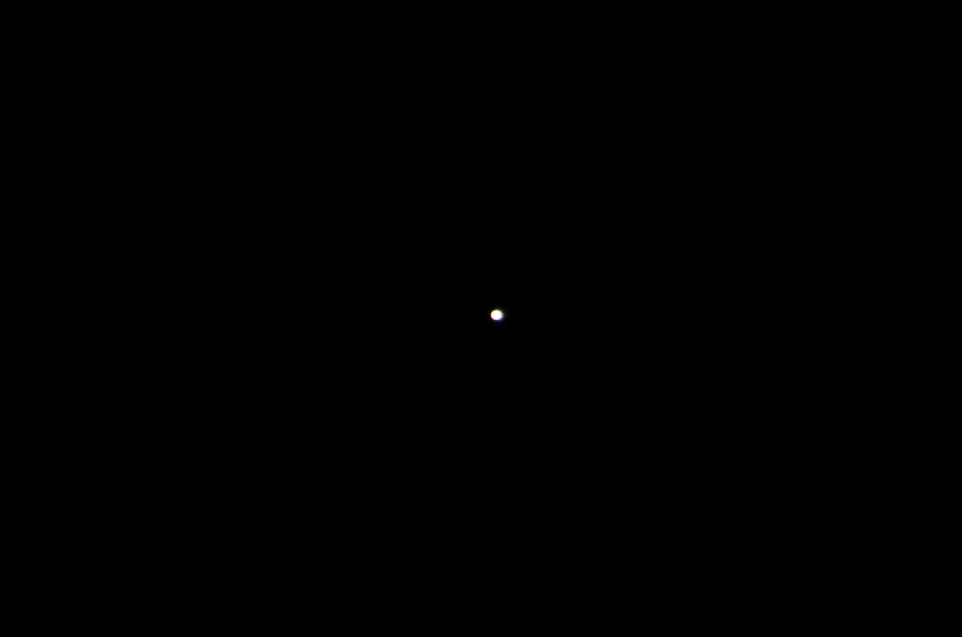
Well there was a nice moon out and Jupiter and Saturn… sooo… I used my bahtinov mask to focus in on Jupiter (since it’s nice and bright) and snapped this pic of it… focus ok, over exposed Jupiter, but I get 3 moons:

Then, I get the focus and exposure better, but no moons (unless I push some sliders in lightroom)

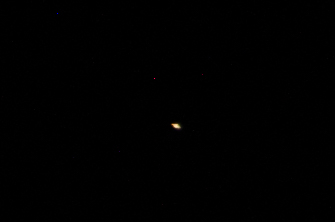
Then I take a shot of Saturn… oh… it is pretty far away at 200mm it’s just a few pixels, but you can imagine it’s overall shape:

That’s greatly cropped, but if you click on it I hope you can see it πŸ™‚

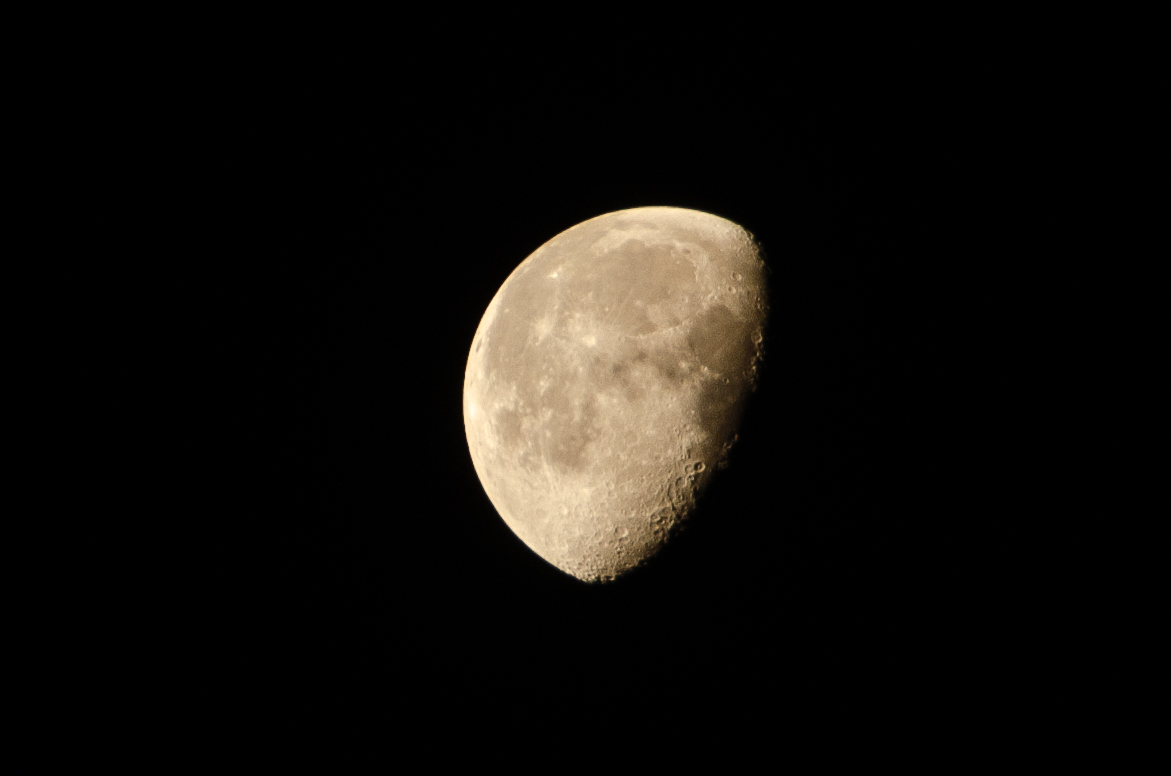
And now what you’ve been waiting for… here is a nice pretty well focused and exposed shot of the moon:

I told myself i would not get up in the wee hours of the night for photos — I really need sleep, my new plan was ok, just do solar stuff till we get into winter when it gets dark enough while I’m still awake…

Analysis of My Astra V2.1 Tracker’s timing

So I’ve built a star tracker, and with a 40mm lens and only using an iPhone compass and bubble level to polar align it, I was able to get 30 second photos without star trails.

But I need to push the envelope. I want longer exposures and now have an external intervalometer to do that, and I also want to be able to use my 18-200mm lens at 200mm.

Initial tests with the 18-200mm lens, again with iPhone alignment, said — I get star trails.. So I set it up level in the house, and ran it for a while with the camera on and the iPhone level on it, making casual readings with a stop watch, and for sure, the lens was probably too heavy for that little stepper and an 8mm pitch lead screw.

So I got a 4mm pitch lead screw, it should be able to lift twice as much right? Got up at some insane time of night and took photos at 200mm and got star trails.

Ok, so there are at least two things that cause this… ok 3 things. One is that the longer the lens the more inaccuracies of the whole setup will show and cause star trails. Two is that if the polar alignment is out… you get star trails, three if the system clock of the microcontroller is inaccurate, you get star trails.

So to get a lot more precise in looking for causes, I did this:

I set the tracker up level on a tripod in my house. I put a big X on white background registration mark at the pivot, and at the end of the arm that swings. And I made a 30fps HD video of it for about 16 minutes.

That’s the data collection, now for processing I loaded the movie file into blender and used object tracking to track those two marks for the 16 minutes of the video.

Then I played all day with blender… ok but really then I wrote a python script that transforms the swing arm tracker’s position so that the pivot position is the origin — for each frame and printed to a file the angle of rotation of the swing arm tracker about the pivot origin.

Now by subtracting the start angle from the end angle, I had the total degrees (Yes I work in degrees not radians πŸ™‚ swung in 16 minutes… it should have been so close to 4 degrees it’s not funny. But it actually came out to 3.75 ish degrees which is 6% slow.

That and a bad polar alignment probably explains star trails… since the stars are rotating slightly faster than the camera. For short exposures, it might not be noticeable, but I want long exposures, and I believe I can do it with this tracker with a little work.

Let see, does this data imply that I “should” see star trails in a 60 second exposure… We can figure this out… Photo Pills will give the max exposure time for an untracked photo with a given camera and lens combination. For my camera and that lens it says the NPF rule for it says max exposure of .94 seconds before a noticeable star trail. Ok, so 6% of 60 seconds is 3.6 seconds.. so I should see star trails due to the difference between .94 and 3.6, and Yes I did. Also I also took exposures at 30 seconds – which are 1.8 seconds slow… again that’s greater than .94 seconds, and yes I saw trails.

So the barn door tracker is basically a sidereal clock. At the root of it is it’s dependence on an accurate system time, since the amount of turns per degree for the lead screw depends on how wide the hinge is already open… Unlike a tracker with a curved screw, this tracker has a straight screw so the steps per degree needs to be variable.

Well the system clock on the ESP32 is based on a quartz crystal and so that in itself is very accurate, but there are a plethora of other places inaccuracies come in. Like we’re dealing with physical things all manufactured to their individual tolerances… the screw is a 4mm pitch screw, but not exactly 4mm. The stepper has so many steps per revolution, and that should be accurate, but how accurate? The trigonometry used in the program to compute the number of steps at time T, depends on the dimensions of the tracker, The designer used the dimensions in the design files, but what I have is something printed on my printer… My printer prints things to pretty accurate dimensions, but accurate enough? How far of from ideal?

So you could go through the whole system looking for sources of inaccuracies… and try to refine things, but there is another approach….

So in 16 minutes I measured a 6% discrepancy in angle… (ooh.. there’s also inaccuracies in my measurements too), how consistent is that? Well looking at the star trails in a 1 minute exposure gives me nice clean looking trails… if there was any speeding up and slowing down cycle, or just changes in speed the thickness of the trails would not be nice and uniform.

So on the assumption that the system all together is slow, what I can do is make a longer measurement. Set it up again, and video it for like 2 hours (that max I’d want to use the thing without resetting it)… and run that through my Blender code. From that I should be able to make a time dependent correction factor to the number of steps needed at any given point in time to bring it into correct timing.

It’s worth a try — alternatively I say — well this was fun— and spend thousands on a manufactured equatorial mount, and a guide scope… Thousands. Of. Dollars.

I think I’ll try the hardware hacking approach.

Update on the failure to make a polar alignment scope

OK, so a few days back I posted about a couple clips I made so I could attach a red dot finder to both my camera and my Astra tracker.

See that entry for how I thought it should go, but how it actually went was I could not calibrate the scope. No matter how much I tried I got star trails even at 30 sec exposures, and the other night, just using an iPhone compass and level I was able to do 1 minute exposures with no trails.

So back to the drawing board. A person on thingiverse.com posted a shoe to attach the same red dot finder that I bought to the Astra. It has a lower profile and it looks like it will be far less wobbly than the one I made.

I do still need to adapt it to attach to my camera hot shoe, because I have no other way I can think about to calibrate the finder. It has 2 thumb screws one for fine adjust up/down and one for left/right.

To adjust to adjust those on the mount alone seems impossible.. You’d have to use the iphone to get a rough alignment, dial the scope to the north star, take a photo, see if it trails and then… what?… guess which way to move the mount and trial and error hunt for no trails?

No I figure if I attach it to the camera on a tripod, center a bright star in the camera view, which seems easy since there is a red box to center it in, dial in the finder, move the finder to the Astra mount, and well it should now be easy to point that at the north star.

It will take another sleepless, but clear, night to try again… I got up at 3:30am today, and clouds rolled in by 4:45, so also there’s not a lot of time to experiment in a cloudy region.

Progress on the Solar Tracker

Well I made progress on the solar tracker. All 3D printing done. Mechanical assembly done.

Assembled Tracker on Tripod

Next, I need to solder pins onto the ESP32 and wire it up and figure out where the two stepper driver boards go.

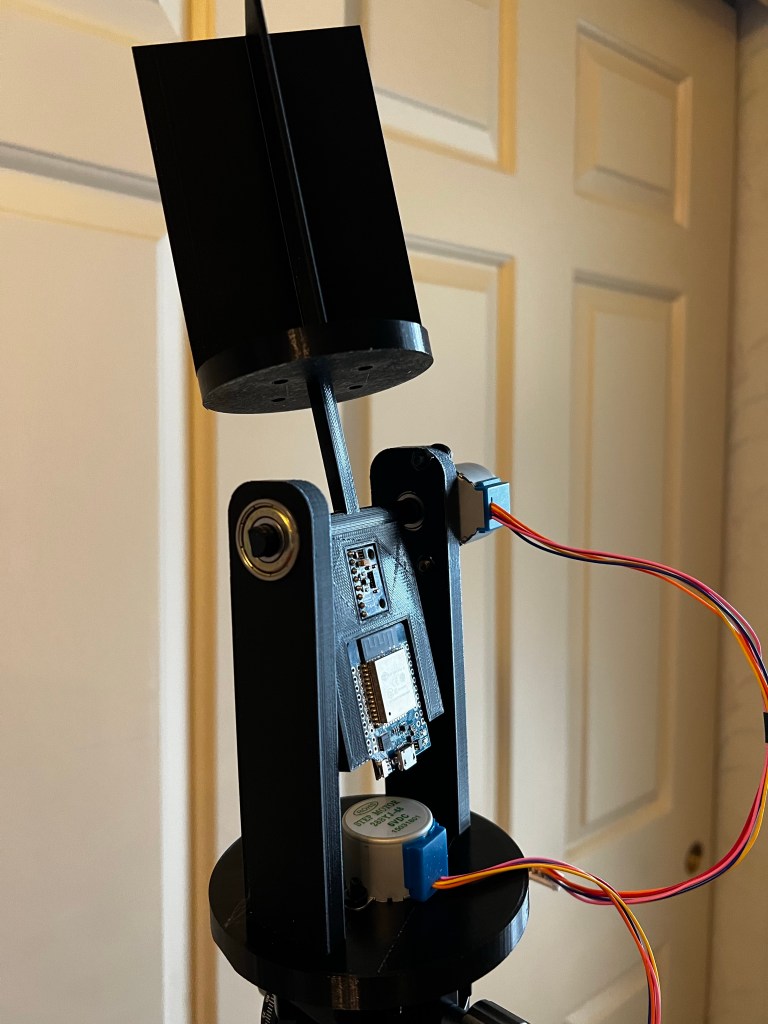
closeup of the electronics

As you can see the electronics fit into recesses in the tilting platform. the smaller module is the magnetometer /accelerometer.

In practice, the azimuth axis needs to spin about 370 degrees while the code does compass calibration. Since the wiring between the esp32 and the stepper move together on the axis that wiring won’t be a problem, but the usb cable feeding power and serial will have to have enough slack for the full rotation.

On the alt axis, the wiring to the stepper only needs enough slack for 90 degrees of tilt. the software will prevent over rotation. However, again, the usb cable might be a problem as you can see there is not a lot of clearance for the connector between it and the stepper.

Once the software is finalized, io to the tracker will be over wifi, so instead of a usb cable, I should be able to attach batteries and a voltage regulator, so then only two power lines will attach to the esp32, making cableing easier.

Update on the Solar Tracker/Logger

Well I did choose to go with an ESP32, I’ve already written the code, which I’ll tweak once everything is together. And I did get the first draft of the 3D printed parts:

Which consists of a:
1. Base — that fits on an Arca tripod mount (I borrowed the arca part from another person’s design. If I make this project public I’ll let people know where to get the arca mount that they can add to my adaptor to make the base.
2. Rotating Base — this is the azimuth axis.. it swivels on a single skate board bearing, direct driven by a stepper.
3. A Sensor Head — This holds 4 photo resistors, and has baffles that will cast shadows on them if the sun is not aligned. So basically if any pair of sensors reads the same voltage, they are both in full sun and so aimed in that dimension at the sun. as the sun moves, a shadow will be cast on one of them, the voltages will differ in the pair and the code steps the appropriate motor to get the voltages equal again.
4. A tilt platform — This is the alt axis. This platform rotates on 2 skateboard bearings, one end is direct driven by a stepper. The sensor head attaches to this. Also there are recesses to put the ESP32 and magnetometer/accelerometer.

What the code does is sense the voltages on the circuits the sensors are connected to, step the motors to equalize the voltages — this aims the tilting platform in alt and az at the sun, then reads the mag/accel sensor for heading and tilt. It will run a web server and allow a client to get the latest: alt, az and time those readings were taken. (I synchronize the ESP32’s clock by NTP to my NTP server in the house.) A raspberry pi will act as the client, and log sun positions, and yes, perform the necessary adjustment to go from magnetic heading to true heading.

What’s missing? Well right now there is no place for the stepper drivers to sit. So they’ll just hang out. Also it probably needs to have the tilt platform balanced, it seems like it will be weighted towards the sensor head. Testing will tell if the stepper has enough torque so that this is not a problem. if it is a problem I’ll glue some weight onto the electronics platform.

Let’s make a solar tracker! or — how to use a couple extra stepper motors.

I have 3 more stepper motors left over from the star tracker project and I have an idea.

One thing I realize is that mid summer is not really such a good time to be doing astrophotography, since there are so few hours of actual darkness. So how about some solar observations?

I tried was hold a rod on my driveway and measure the compass direction of the shadow, and wow it was within 5 degrees of where it should be (comparing to a solar calculator app). But wait! Why is it so far off? Is the sun in the wrong spot?

I don’t know, so I’m going to get a little more technical and try to track and log sun positions.

There are several examples of solar trackers online, things that use photo cells or photo resistors and either simple motors or Arduino setups that point themselves towards the sun… What I’d like to do is to do that, but also do data logging of where the sun is.

So a simple design would be an alt/az tracker, I bought a bunch of photo resistors, I have a 3d printer and I have spare microcontrollers, and I even have a GY-511 accelerometer/magnetometer module so I should be able to sense the direction and angle of inclination of the tracker. I need to order an SD card module oh and a 3.3v regulator — don’t depend on the microcontroller’s on board regulator for the SD card reader — it actually draws quite a bit of milliamps.

So that’s the plan and of course I will keep progress posted here and on Youtube.

Update: Because I’d rather not wait for an SD card reader to come in, as long as the ESP 32 can run a web server, I’ll just have the ESP 32 and the GY-511 onboard, I’ll do the data logging in the house with one of my Raspberry PIs. Nice thing about this is I also don’t need the external voltage regulator because the GY-511 takes 5 volts in, I can grab that from the USB power pin. So I’m going to need 8 data pins to drive the steppers, and 2 pins for i2c to communicate with the GY-511, and it looks like that will just work out… the ESP32 I’m using is the MH-ET LIVE MiniKit. It’s a compact design, so instead of a long board with a row of pins on each side, it’s half sized, so two rows of pins right together on each side. To use it on a bread board you’re limited to just using one row on each side, so though the board has lots of GPIO, on a bread board you don’t have access to all of them (Unless, as I’ve done in the past you use a row on each side for pins that plug into the breadboard, and then pins facing up on the top for the other 2 rows..